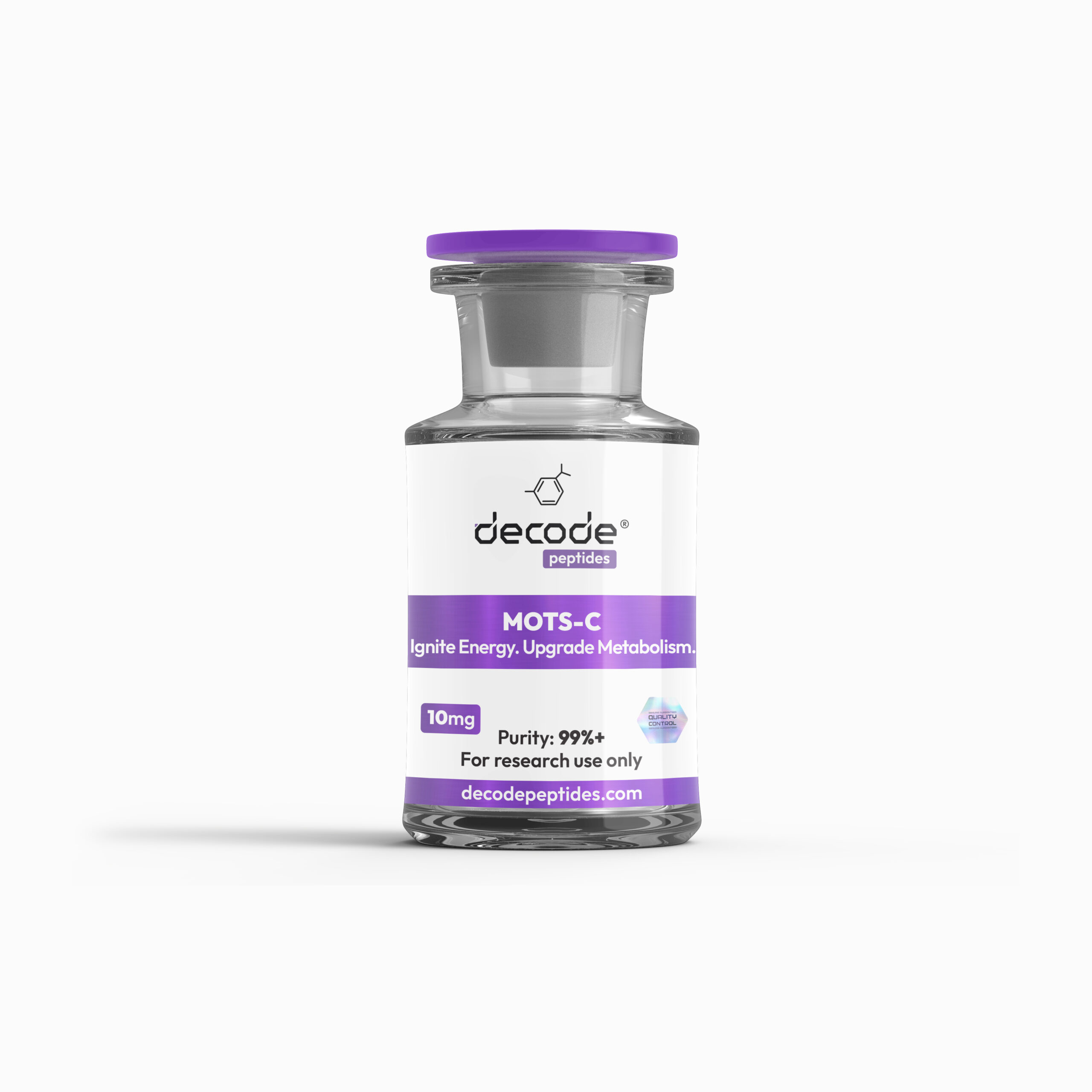
MOTS-C (Mitochondrial Open Reading Frame of the 12S rRNA-c) is a 16 amino acid mitochondria-derived peptide encoded within the mitochondrial 12S ribosomal RNA gene. It is one of the most recently discovered mitochondrial peptides, studied for its profound effects on metabolic regulation, insulin sensitivity, exercise capacity, and aging. Each vial contains 10mg of research-grade MOTS-C.
Reconstitution requires bacteriostatic water (sold separately). Use the reconstitution calculator →
COA with every batch
Independent EU lab, ≥99% HPLC
Secure encrypted checkout
Card payments over TLS
Discreet packaging
Plain outer box, no branding
EU dispatch in 24–48h
Tracked delivery
Cold-chain handling
Temperature-controlled transit
About this compound
MOTS-C is a 16-amino-acid peptide encoded within the mitochondrial 12S rRNA — a region previously considered non-coding. Discovered in 2015 by Lee et al. at USC, it is a founding member of the mitochondrial-derived peptides (MDPs) — a new class of retrograde signalling molecules that travel from mitochondria to the nucleus to regulate energy homeostasis. MOTS-C plasma levels decline with age and obesity, making it a key biomarker and research tool for metabolic dysfunction, exercise biology, insulin resistance, and longevity — with its unique AMPK activation mechanism entirely distinct from any existing pharmacological class.


Research Data
Research Snapshot — MOTS-C
Key Mechanisms & Pathways
- AMPK Activation via AICARInhibits MTHFD1 in the folate cycle → AICAR accumulation → AMPK phosphorylation at Thr172 — mimicking aerobic exercise.
- Nuclear Retrograde SignalTranslocates from mitochondria to nucleus under metabolic stress, directly modifying ARE/Nrf2 gene expression.
- GLUT4 TranslocationAMPK-driven TBC1D1/AS160 phosphorylation drives GLUT4 vesicle fusion — glucose uptake without insulin receptor activation.
- β-Oxidation EnhancementAMPK inhibits ACC, reducing malonyl-CoA and relieving CPT-1 inhibition → increased mitochondrial fatty acid import.
- mTORC1 SuppressionAMPK phosphorylates TSC2 and Raptor, suppressing anabolic mTORC1 — the signature metabolic state of caloric restriction.
- NF-κB Anti-InflammatorySuppresses IL-6, TNF-α and IL-1β in inflammatory challenge models; improved survival in sepsis models.
Preclinical & Clinical Research Summary
| Research Area | Key Finding | Source |
|---|---|---|
| Obesity Prevention | −35% body weight gain vs. HFD controls; near-normal glucose tolerance restored. | Lee C et al., 2015 — Cell Metab |
| Exercise Mimicry | MOTS-C plasma rises during exercise; exogenous admin reproduces key metabolic training adaptations. | Reynolds JC et al., 2021 — Nat Commun |
| Insulin Sensitivity | Improved skeletal muscle glucose disposal independently of insulin receptor signalling. | Kim KH et al., 2019 — Exp Mol Med |
| Aging / Healthspan | Restored physical performance and insulin sensitivity in aged mice; extended healthspan. | Lee C et al., 2015 — Cell Metab |
References
- Lee C et al. "The mitochondrial-derived peptide MOTS-c promotes metabolic homeostasis and reduces obesity and insulin resistance." Cell Metab, 2015;21(3):443–454.
- Reynolds JC et al. "MOTS-c is an exercise-induced mitochondrial-encoded regulator of age-dependent physical decline and muscle homeostasis." Nat Commun, 2021;12:470.
- Kim KH et al. "MOTS-c peptide increases physical endurance and insulin sensitivity." Exp Mol Med, 2019;51:1–12.
- Bhaskaran S et al. "Mitochondria-derived peptide MOTS-c restores cardiovascular function during aging." Ageing Res Rev, 2020;62:101128.
Specifications
- Sequence
- MRWQEMGYIFYPRKLR
- Molecular Weight
- 2174.5 Da
- Amino Acids
- 16
- Half-Life
- 1–2 hours (SC)
- CAS Number
- 1627580-64-6
- Vial Size
- 10mg
- Purity
- ≥99% (HPLC)
- Form
- Lyophilized powder
- Reconstitution
- Bacteriostatic water (0.9% benzyl alcohol)
- Storage
- Sealed: 2–8 °C · Reconstituted: 2–8 °C, use within 28 days
Research library
Full mechanism breakdowns and peer-reviewed references for this compound.
Researcher reviews
Frequently asked questions
Related research compounds
For laboratory and in-vitro research use only. Not for human or veterinary use, not for consumption. By purchasing, you confirm you are a qualified researcher and accept full responsibility for compliant handling and disposal. Read the full disclaimers.